
What Really Happens Inside a SOC When the Next Breach Hits
Inside a breach, chaos hits fast. Learn more about the reality of crisis response and how rethinking technology and workflow can keep teams faster, clearer, and human.


Every time a major cyber crisis hits, I feel a familiar frustration and, honestly, anger knowing what’s about to happen inside hundreds of SOCs around the world.
Remember Log4Shell? A few weeks before Christmas, everything went off the rails.
Dozens of analysts and managers are thrown into chaos, scrambling to figure out what’s happening. Long nights, endless meetings, and the exhausting grind of trying to understand what to look for, where to look, and how bad it really is.
I’ve been there: as an analyst, shift lead, SOC Manager, IR Manager, and Head of SecOps. I know exactly how painful those hours are: trying to identify, scope, and contain what’s already been compromised while worrying about what’s coming next.
Key Point #1: Define the Right Steps, Fast
The first thing that matters in any crisis is speed and clarity.
You need to define, immediately, what must happen right now. What are the concrete steps your SOC needs to take to identify and assess evidence of compromise?
At the same time, you need to establish new monitoring systems. New detections that focus on this specific event and its potential evolution, regardless of whether the initial attack was successful or not.
And this is where many SOCs lose time. Too many meetings, too many voices, too much coordination before anyone actually acts. Hours or even days are wasted before a single useful query runs.
Technology continues to evolve to assist in situations like this, so teams should adopt responsibly designed technology that helps augment their capabilities to solve these problems.
This is where the AI SOC changes the game. It can instantly outline and execute those actions, kicking off investigations and monitoring while the team gets aligned.
Key Point #2: Keep the SOC Running Without Breaking the Team
Once the plan is clear, the real challenge begins: keeping up the pace.
Crises can stretch on for days or weeks. You can’t expect analysts to run at full speed forever.
AI SOC can scale these long stretches without completely burning out your teams. It can continuously carry a heavy load, running searches, correlating data, enriching alerts, and maintaining new detection logic. That frees your analysts to focus on core operations, while a small group oversees and validates what the AI produces.
The result: no burnout, no confusion, no collapse of regular SOC operations.
The Shift That Gives Me Hope
For years, technology in the SOC has been reactive. New tools are introduced to solve the last problem. We add dashboards, alerts, and integrations. All of it helps, but it often adds more noise than clarity.
What has been missing is a strategic layer. Systems that understand context, support decisions, and help teams stay focused when everything starts to go wrong.
This new approach is not about automation for its own sake. It is about building a SOC that can think and act in parallel: one part manages daily operations, while the other switches into crisis mode without losing rhythm.
When that balance is right, speed does not come at the expense of clarity, and no one burns out trying to keep up. The technology becomes a stabilizer instead of a stress multiplier.
You move faster. You stay operational. Your people stay sharp.
That is what gives me hope. Because when the next big breach hits, we do not have to relive the same painful cycle.
We can respond with precision, discipline, and confidence, not panic.
Anthropic was right (and responsible) to release Mythos first to cybersecurity researchers and a select group of organizations through Project Glasswing. It is a genuinely remarkable model. And the security community should take it seriously. What is available to defenders today will be in the hands of attackers in a few months. That window is closing fast.
Mythos raises the ceiling on what AI can do in cybersecurity tasks. It discovers zero-day vulnerabilities in codebases that previous models could not find. It reverse-engineers complex systems. It constructs sophisticated, multi-path exploits at scale. The capabilities that were previously accessible only to well-funded nation-state actors can now be replicated by a far broader set of threat actors. No longer do you need teams of expert reverse engineers and months of reconnaissance.
The threat landscape is structurally shifting. We will be determined by our ability to shift our defense in kind. Quickly.
Where AI in defense needs to go first
The industry is converging, rightly, on vulnerability research and remediation as the priority. Scanning your own codebase with the same class of models that attackers are using is a clear first step. In many cases, defenders actually have an asymmetric advantage here, as we have better access to our own code than attackers do.
The harder problem is remediation. We already carry significant backlogs of unresolved, sometimes exploitable, vulnerabilities. Unlike an attacker who has nothing to lose, defenders cannot afford mistakes. Our systems are in production. Downtime has real costs. The asymmetry of attacker agility versus defender accountability is where the gap widens.
AI-assisted vulnerability remediation at scale is necessary. But it is not a solved problem, and any honest assessment of the landscape has to acknowledge that.
What this means for security operations
The idea of static detections designed to discover dynamic adversaries is fundamentally misguided. The future is better trip wires and an assume-breach mentality.
For SOC teams, the implications are direct. The scale and complexity of attacks is accelerating. We should expect a higher volume of sophisticated attacks that actively evade detection, that do not conform to known signatures or behavioral patterns, and that are designed from the ground up to stay invisible.
This breaks the model that most SOC programs are built on. The idea of maintaining a library of static detections to catch dynamic adversaries has always had limits. Those limits are now being exposed in real time.
What we need instead is the ability to detect a high volume of low-fidelity signals, such as anomalies in endpoint behavior, data access patterns, email activity, network flows, and identity. This requires teams to investigate each one as if it were the leading edge of a sophisticated breach. Not because every alert is a nation-state intrusion, but rather, we should expect that a higher percentage now may be.
The question is no longer whether to adopt AI in security operations. This is clearly needed. We cannot scale defenses solely on human labor.
The question is how to do it in a way that actually works inside the operational reality that security teams live in.
The real challenge is operational reality
Enterprises have legacy and custom tools, established processes, compliance and audit requirements, escalation paths, and oversight obligations that are not optional. AI cannot simply replace this infrastructure. It has to work within it.
You cannot properly scale your defenses without giving AI access to your organizational context, including your tools, your processes, your detection logic, and your escalation criteria. AI agents need to be able to investigate with the consistency and rigor of an incredible IR analyst, operate transparently, and support human oversight at the points where it matters.
This is precisely what we built Legion to do: meet organizations where they are. Our platform learns your existing tools, processes and context and makes them accessible to the latest frontier models (now Mythos, and every model in the future). From that we create structured, repeatable workflows where consistency is required or fully agentic investigations that require depth and judgment. Every action is auditable. Human-in-the-loop controls are configurable. And the system integrates across your entire stack.
My conclusion - Assume breach, investigate everything, build for the attacker that has already found the vulnerability you have not patched yet, and is using Mythos-level models to stay ahead of your detections.

In the wake of Mythos and Project Glasswing, security operations teams need AI that meets them where they are.

Picture a senior analyst mid-investigation. Eight browser tabs open across CrowdStrike, VirusTotal, Defender, and Microsoft Entra. She's running a hunting query in one window, checking an IP reputation score in another. And somewhere in between, she's documenting. Taking screenshots, copying log entries into a case note, capturing context before it slips away.
This is the job. Investigations today aren't just about finding the threat. They're about moving across tools, pulling together evidence from a dozen different sources, and building a record that another analyst, or an auditor, or a manager, can actually follow. The documentation isn't a distraction from the work. It is part of the work.
Everyone in security has lived that.
Which raises a question that's been easy to ignore until now: if we wouldn't accept an analyst who said "trust me, I looked at it"- why are we accepting that from AI agents?
Evidence Has Always Been the Standard
The reason SOC analysts document isn't distrust. It's precision. A good investigation has always meant showing your work. The summary an analyst writes is their claim, the insight they've drawn from what they saw. The screenshot is the fact. Undisputable evidence, captured at the moment of discovery. Together they tell the full story: here is what I found, and here is the proof.
.png)
Evidence gathering has always been a core part of the job. Screenshots and logs aren't bureaucratic overhead. They're how you distinguish signal from noise, how you close out audit findings, how you hand off a case without losing context.
You Wouldn't Accept "Trust Me" From an Analyst. Stop Accepting It From AI
We hold human analysts to a clear standard. When an analyst closes a case, we expect to see their work. The exact screen they reviewed, the exact query they ran, the exact result that informed their decision. A summary of what they found is a claim. The screenshot is the proof.
We should hold AI agents to the same standard.
Today, most AI SOC give you a verdict and a reason. The agent processed the alert, evaluated the indicators, and concluded it was malicious. But if you ask what it actually saw, you're directed to API logs and structured JSON responses. That's not evidence. That's a reconstruction built after the fact, from data that was never meant to be read by a human auditor in the first place.
The gap between what an AI agent did and what you can actually verify is where hallucination risk lives. A summary can sound confident and still be wrong. Without visual evidence captured at the moment of the decision, you have no way to know what the system actually encountered.
Legion operates differently. Instead of calling APIs, Legion navigates your source systems directly through the browser, the same way a human analyst would. It opens the actual system, reads the actual screen, and captures a screenshot of exactly what it sees at every step. The summary is the claim. The screenshot is the fact.
That's the standard we believe AI investigations should meet. And it's the only architecture that meets it.
How Legion Automates Evidence Gathering
Legion Evidence Gathering captures visual proof of every action Legion takes as it navigates your source systems, automatically, in real time.
.png)
Take a malware investigation spanning CrowdStrike, VirusTotal, and Defender. Legion opens the originating ticket, reads the case, and begins investigating. As it moves through each tool, it takes a screenshot at every step. The CrowdStrike detection page as it appeared. The VirusTotal result in context. The Defender hunting query and its output. Every interface, exactly as Legion saw it.
By the time an analyst opens the case, the full evidence gallery is already there. Screenshots organized sequentially, labeled by tool, timestamped, and ready to review. Not just a summary. Not just a log. The complete picture: the analysis and the visual evidence behind every conclusion.
And it stays there. Every investigation Legion runs is stored and searchable. When an auditor asks a question, when a peer analyst picks up a handoff, when someone needs to understand why a decision was made, you go back to the session and everything is right there. Every step. Every screen. Nothing reconstructed. Nothing missing.
Different alert types. Different toolchains. The same complete evidence gallery, every time.
This Is What Accountable AI Looks Like
We've always known what a good investigation looks like. You show your work. You back your conclusions with evidence. You leave a record that someone else can follow. Legion applies that same standard to every automated investigation it runs, without exception and without manual effort. The bar doesn't move because the analyst is an AI. It stays exactly where it's always been.
See Legion Evidence Gathering in action. Request a Demo
.png)
Legion automates evidence gathering during AI-driven investigations, capturing screenshots from live security tools at every step, so every conclusion is backed by visual proof.

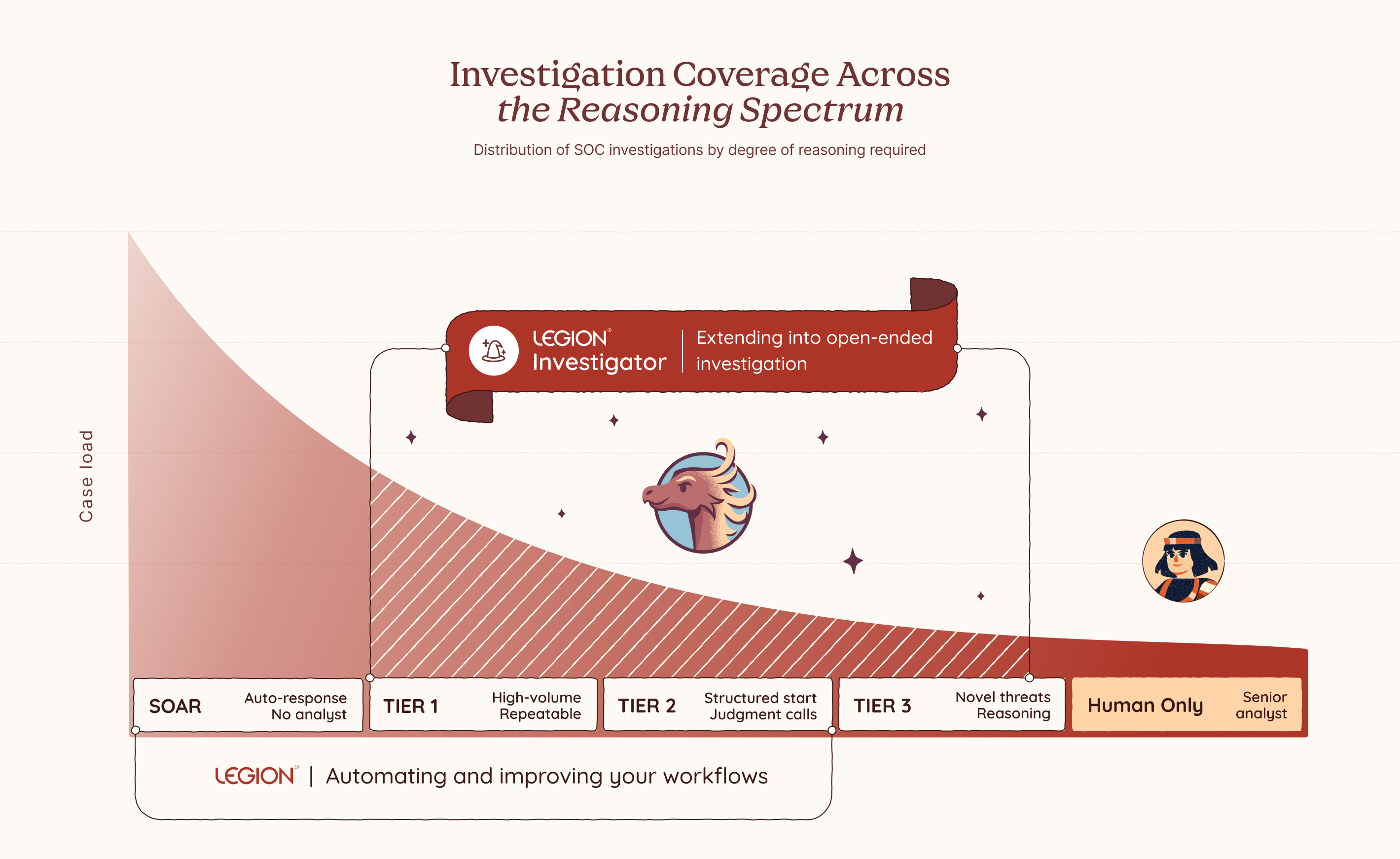
SOC investigations range widely. Some are highly repeatable: every step defined, every decision documented. These work well and can be fully automated. But some investigations eventually reach a point where that breaks down: where the next step depends on what you just found, and the judgment and intuition to know what it means.
You can see it clearly the moment you try to write it down. Some processes flow neatly from start to finish. But as soon as you move into more complex investigations, the cracks appear. You find yourself pulled into a spiral of edge cases, tool variations, and fallback paths. You add branches. Then branches on branches. And after all that effort, you almost always end up in the same place: where no rule applies, and only judgment, reasoning and intuition can take you further.
The Part You Can Never Quite Capture
SOC investigations don't all look the same. Some are fully deterministic: a user notification when an outgoing email gets blocked, no reasoning required. For these, consistency matters. The same steps, the same outcome, every time. Others are the opposite: novel threats with no fixed path, no known pattern, where only experience, intuition, and judgment can tell you what to do next. And many fall somewhere in between, where you start with structure and hit a point where judgment has to take over.
But even those flows have a ceiling. Take a phishing investigation. You can document the triage steps pretty cleanly: check the sender, analyze the headers, detonate the attachment, check the URLs. That part is routine and capturable. But the moment you find something suspicious, the investigation shifts. Now you need to reason about scope: is this part of a campaign, and who else was hit? That question has no fixed answer. You might search for other emails with the same subject, but any decent campaign will vary the lures across targets, changing subjects, sender names, and payload links to evade detection. You cannot match on a single field and call it done. You need to iterate: follow one thread, see what it reveals, adjust your search, go again. You are reading the environment in real time, making judgment calls at every step based on what the last one uncovered.
Those judgment points show up on every shift, on every alert that goes beyond the routine. Someone has to reason through them in the moment, with whatever context they have, under whatever pressure exists right now. Until 3am. Until a less experienced analyst picks it up. Until alert volume means there simply isn't time to think it through properly.
That reasoning is not pre-programmed. It emerges from the finding itself. It is what a senior analyst does instinctively, and until now there has been no way to replicate it at scale. Legion Investigator is built for that moment.
Your Environment. Your Logic. Your Investigator.
Legion Investigator is a goal-oriented AI agent that sits inside your investigation workflow at exactly the moments where reasoning takes over from execution, extending Legion's coverage across the full spectrum of SOC investigations, from fully deterministic workflows to complex open-ended investigations. You define its goal, you choose which tools and actions it is permitted to use, and you decide where it acts autonomously and where it checks in first.
Which category a given investigation falls into is sometimes obvious. But often it is a deliberate choice, one that should be yours to make based on your team's needs, your risk tolerance, and how much consistency versus flexibility the situation calls for. Where on that spectrum each investigation runs is yours to decide. Every boundary is one you set in advance and can trust will be respected. This is what makes Investigator the kind of AI enterprises can actually adopt: not just powerful, but designed from the ground up to operate within your constraints, your processes, and your level of trust.
Most AI SOC tools bring their own model of how investigations should work. Legion Investigator learns from how yours actually do. It builds its understanding from your team's recorded investigation sessions, the decisions they make, the paths they take, and the patterns that emerge across real cases in your environment. Over time, Legion builds a structured knowledge base specific to your organization, capturing your processes, your tooling, and your team's accumulated expertise. That knowledge is not just stored. It is actively used to improve your captured workflows and feeds directly into how Investigator reasons, prioritizes, and investigates.
And when we say your tools, we mean all of them. Legion Investigator works the way your analysts work, through the browser, with no integrations and no APIs required. Your SIEM, your EDR, your threat intelligence platforms, your homegrown applications, your legacy dashboards, your on-prem and cloud environments. You don’t rebuild your stack to fit the tool. The tool fits your stack.
The way it works reflects how investigations actually flow. An investigation might start in your SIEM with a set of routine queries, structured, reliable, repeatable. But when it reaches one of those decision points, you hand off to an Investigator with a goal: find the scope of breach, enrich the full context of what we have so far, identify what else was impacted across endpoints and cloud assets.
The Investigator takes that goal and works toward achieving it. It invokes the relevant tools, interprets what comes back, recalculates what to do next, and invokes again. It keeps going, step by step, until the goal is met. Not a single tool call with a result handed back to you. A full reasoning loop that runs until the work is done, across your security tools, your homegrown applications, and any AI agents already running in your environment. Investigator acts as the orchestrator, pulling in whatever is needed to get there.
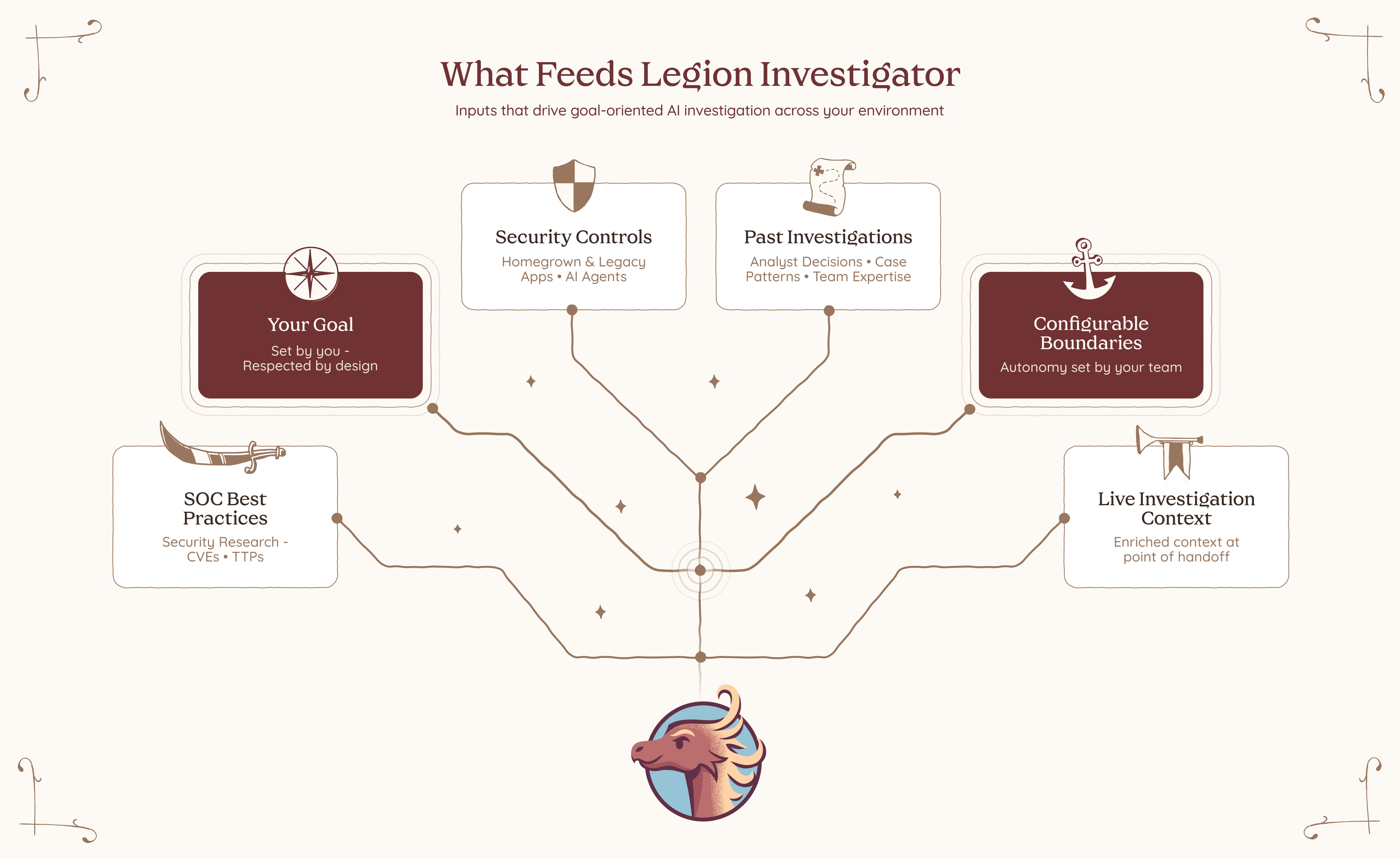
Multiple Investigators can work together across a single investigation. One handles enrichment. Another determines scope of breach. A third drives containment based on what was actually found, not what was anticipated when the playbook was written.
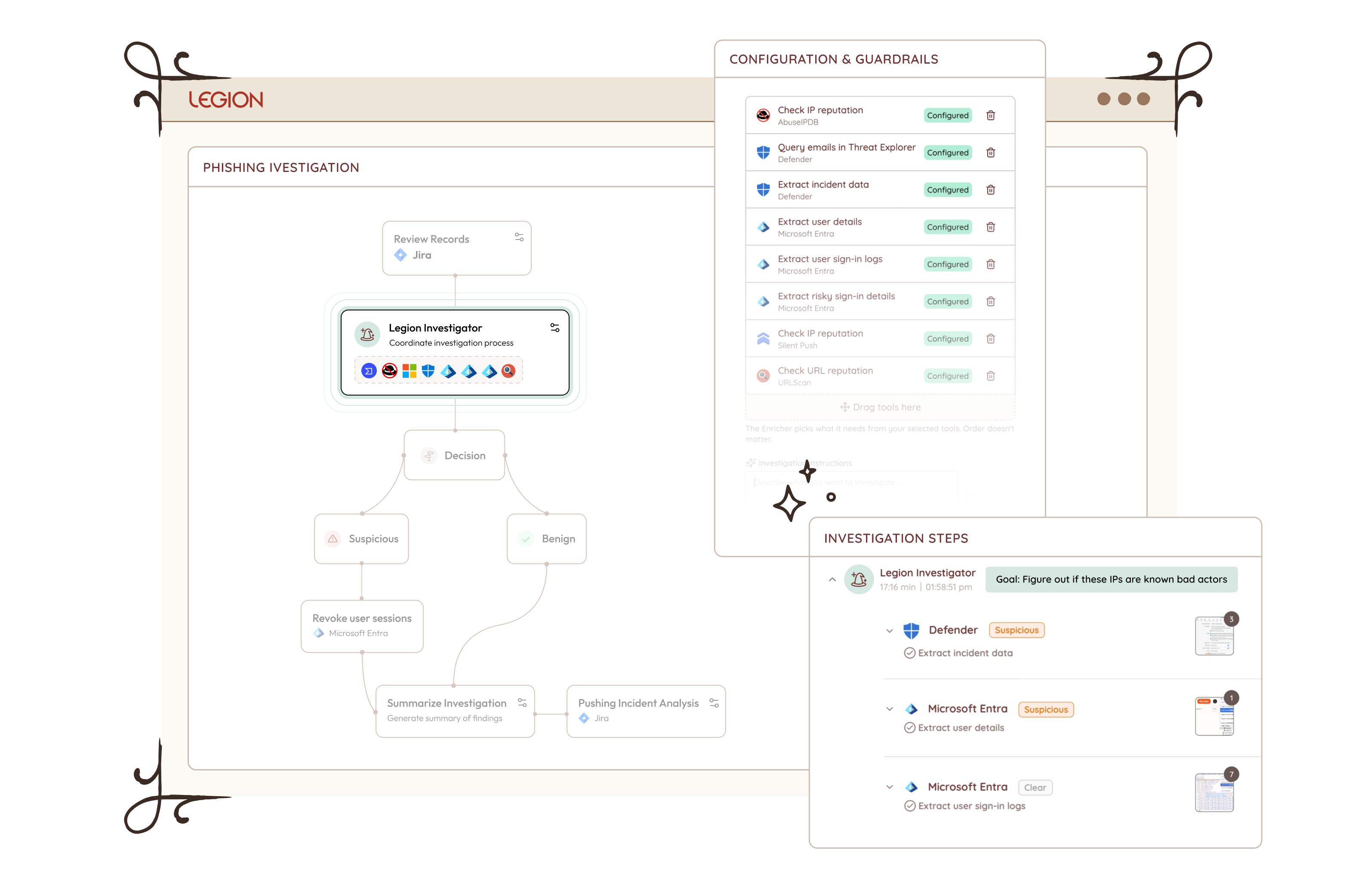
And because trust matters, Investigator operates within guardrails. It works only with the tools and actions it’s been given permission to use. For anything higher risk, it asks before acting. You stay in control by setting the boundaries in advance and knowing they’ll be respected.
What This Changes
Legion Investigator opens up three things that weren't possible before.
Pick up where deterministic processes end
For investigations where you have structured steps, you can now embed an Investigator at exactly the points where structure runs out. The routine parts stay routine.The investigator reasons further, and by the time you step in, the groundwork is already done.
Handle your long tail of alerts
For the long tail of investigations where you never had a well-defined flow to begin with, you can now hand them off end to end. The Investigator handles enrichment before you even open the case, drives containment the moment scope is confirmed, and picks up every judgment point in between. Give the Investigator the goal, set the guardrails, and let it run. No playbook required.
Every investigation, regardless of how well-defined it is, can now be handled with the depth of your best analyst, on every alert, on every shift. And for the first time, you control where on that spectrum each investigation runs. More structure where consistency matters. More autonomy where judgment, experience, and intuition are required. The balance is yours to set, and yours to change.
This is not about replacing analysts. It never was. There will always be moments that require human judgment, experience, and instinct, and no AI should pretend otherwise. What changes is everything around those moments. The analyst becomes the commander: setting goals, defining boundaries, sending investigators out into the environment to gather, reason, and report back. The calls that matter stay with you. The work that surrounds them no longer has to. Not because we built a smarter AI. Because we built one that learned from you.

Introducing Legion AI Investigator: AI that reasons where playbooks can't. Define the goal, set the guardrails, and let it investigate across your tools — no integrations required.